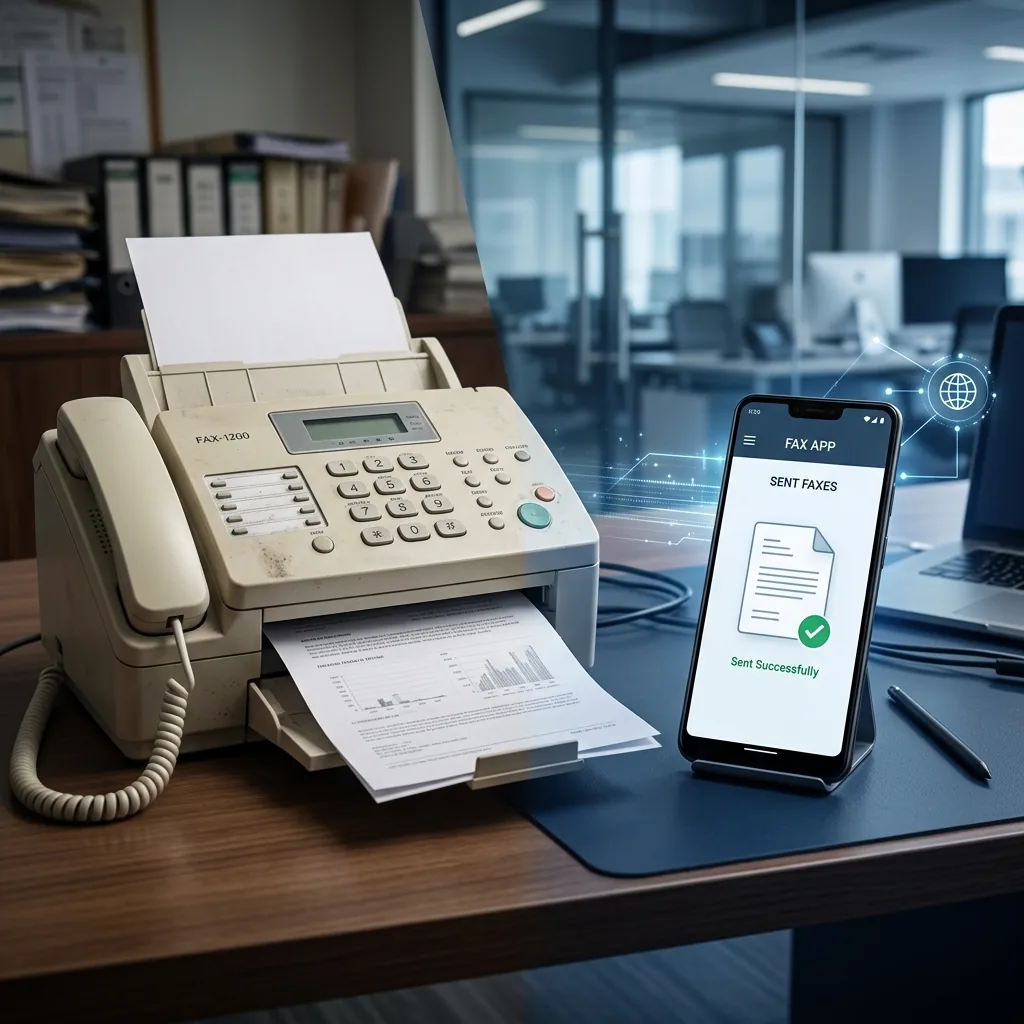
Everyone loves declaring fax dead. It’s the easiest hot take in technology commentary — right up there with “email is dying” and “nobody uses desktop computers anymore.”
Except the data tells a completely different story.
In 2025, over 75% of all healthcare communications in the United States still moved through fax. Not email. Not secure messaging portals. Not Slack. Fax.
The Department of Veterans Affairs alone processes over 150,000 fax pages every single day. Every hospital, every clinic, every insurance company, every pharmacy — fax is the invisible nervous system connecting the American healthcare system.
And healthcare is just the beginning.
The industries that cannot quit fax
Healthcare depends on fax at a fundamental infrastructure level. Referrals, lab results, prior authorizations, prescription transfers, insurance claims, discharge summaries — the entire patient lifecycle is stitched together with fax transmissions. HIPAA regulations actually make fax easier to use than standard email in many clinical contexts, because email isn’t encrypted by default while the fax protocol is inherently point-to-point.
Legal relies on fax for court filings, inter-counsel correspondence, signed affidavits, and process serving confirmations. Many courts still require or accept faxed submissions for time-sensitive filings. The timestamp on a fax delivery confirmation is legally defensible in ways that email read receipts simply aren’t.
Financial services uses fax because banks and compliance departments trust the transmission model. Wire transfer authorizations, KYC document submissions, and regulatory filings move by fax because it’s point-to-point — unlike email, there’s no server-hopping, no forwarding chain, no BCC exposure.
Government at every level — federal, state, local — runs on fax. The IRS accepts faxed documents. Social Security offices process faxes daily. Permit applications, license renewals, and regulatory submissions flow through fax because government systems were built decades ago and replacing them would cost billions.
Real estate lives and breathes fax. Purchase agreements, title transfers, mortgage documents, and inspection reports — title companies and lenders depend on fax transmissions daily for time-sensitive closings.
So no, fax is not dead. Not even close. The protocol itself — T.30/T.38 — is actually remarkably resilient and secure during transmission. The signal travels from Point A to Point B with no intermediate storage, no routing through third-party servers, no exposure in transit.
The problem was never the fax protocol. The problem is the hardware sitting on the counter.
The machine is the weakest link
Here’s what happens at most offices with a physical fax machine.
A document arrives at 7 PM. The office is empty. It prints out and lands in the tray. The cleaning crew comes through at 9 PM. The next morning, the office manager arrives at 8:30 AM and finds the document — which might contain a patient’s lab results, a client’s Social Security number, or a confidential settlement agreement — sitting face-up in a tray that’s been accessible to anyone for over 13 hours.
During those 13 hours, there was no encryption protecting that printed page. There was no access control determining who could see it. There was no log recording who walked past the machine. There was no way to know whether anyone read it, photographed it, or removed it.
If the machine ran out of paper during the night, the incoming fax might have been lost entirely. No notification. No retry. Just gone.
The irony is painful: the fax transmission was perfectly secure. The point-to-point protocol worked exactly as designed. But the fax reception — a piece of paper sitting in an open tray in an empty office — was a compliance disaster.
This is the disconnect that most people miss when they debate whether fax should still exist. The protocol is fine. The physical machine is the vulnerability.
What is cloud fax? The evolution of faxing without a machine
Around 2015, a category of services emerged that separated the fax protocol from the physical hardware. Cloud fax services — sometimes called online fax services or electronic fax — keep the transmission protocol but eliminate the machine entirely. So what is cloud faxing, exactly? It’s a way to send and receive faxes using the internet instead of a physical machine, while maintaining full compatibility with traditional fax machines on the other end.
How sending works: You upload a PDF, Word document, or image through a web app or mobile fax app. You enter the recipient’s fax number. You click send. The cloud service converts your digital document into a fax signal and transmits it over the phone network. The recipient’s fax machine on the other end prints it normally. They cannot tell the difference. You can send a fax from your computer, fax from your iPhone, or use any device with internet access.
How receiving works: Someone sends a fax to your number. The cloud service receives the incoming fax signal, converts it to an encrypted PDF, and delivers it directly to your inbox — either email or in-app. No printing. No tray. No physical exposure. No chance of a missed fax at 3 AM sitting in an empty office.
The protocol stays. The machine disappears. The security gap closes.
A real-world transition
A 15-physician multi-specialty clinic I consulted with was processing roughly 200 faxes per day through two physical machines. Paper jams were constant. Toner needed replacing every few weeks. Each machine had its own dedicated phone line at $45/month.
But the operational costs weren’t what worried the practice manager. It was the compliance exposure.
Over 18 months, they had three documented incidents where incoming faxes containing Protected Health Information were left in the tray overnight. In one case, a patient’s psychiatric evaluation printed at 8 PM and sat face-up in a communal hallway until 7:30 AM. Under HIPAA’s Security Rule, that’s exactly the kind of exposure that can trigger enforcement action — with individual violation penalties ranging from $100 to $50,000 per incident.
They migrated to cloud fax in a single weekend.
Day 1: Created cloud fax accounts for each department — front desk, referral coordination, billing, nursing.
Day 2: Ported both existing fax numbers to the cloud provider. Same numbers, new infrastructure. Patients, insurance companies, and referring physicians didn’t need to update anything on their end.
Day 3: Tested for 24 hours. Every incoming fax arrived as an encrypted PDF in the correct department’s inbox. Every outgoing fax was sent from the web interface.
Day 4: Unplugged the machines.
The cost results:
Before the switch, their physical fax infrastructure was costing approximately $200/month in hard costs — phone lines, paper, toner, maintenance — plus roughly 3 hours of staff time per day standing at the machines. After the switch, their total cost dropped to $25/month with about 20 minutes of daily staff time.
First-year savings exceeded $2,000 in hard costs alone. But the real value was eliminating the HIPAA exposure — one fine would have cost more than a lifetime of cloud fax subscriptions.
Three trends accelerating this shift
Regulatory pressure is increasing. HIPAA enforcement has intensified. State attorneys general are bringing more data privacy actions. GDPR applies to any organization handling EU citizens’ data. Physical fax machines — with their open trays and zero access controls — are increasingly difficult to defend as “reasonable safeguards” in any regulatory context.
Remote and hybrid work is permanent. If half your staff works from home two days a week, they can’t walk to the fax machine. Cloud fax works from a laptop, phone, or tablet — anywhere with internet access. You can send a fax from your phone just as easily as from the office. The fax number stays the same; only the delivery mechanism changes.
The cost gap keeps widening. Dedicated analog phone lines are getting more expensive as telecom companies phase out legacy infrastructure. Meanwhile, cloud fax services are getting cheaper and more feature-rich every year. The economic argument for keeping physical machines has collapsed entirely.
The bottom line
Fax isn’t going anywhere. Too many critical industries depend on it, too much regulatory infrastructure is built around it, and the underlying protocol is genuinely sound.
But the physical fax machine — the hardware, the paper tray, the dedicated phone line, the toner cartridges, the open-access vulnerability — that’s the part that needs to disappear. It’s the weakest link in the chain: expensive, insecure, and increasingly indefensible.
The organizations that have already made the switch aren’t nostalgic about it. They’re spending less, operating faster, and sleeping better knowing that sensitive documents are no longer sitting in an open tray at 3 AM waiting for anyone to walk by.
If you’re still running a physical fax machine in healthcare, legal, or financial services — the question isn’t whether to switch. The question is what you’re waiting for.
Frequently Asked Questions
What is cloud fax and how does it work?
Cloud fax — also called online fax or electronic fax — is a service that lets you send and receive faxes over the internet without a physical fax machine. When you send a fax, the service converts your digital document into a standard fax signal and transmits it over the phone network. When you receive a fax, the incoming signal is converted to an encrypted PDF and delivered to your inbox. The person on the other end uses their regular fax machine — they can’t tell the difference.
How does a fax machine work compared to cloud fax?
A traditional fax machine scans a physical document, converts it to audio signals, and transmits those signals over a phone line to another fax machine, which converts them back into a printed page. Cloud fax uses the same underlying T.30/T.38 protocol but replaces the physical machines with software. The result is the same transmission — but without the paper, toner, dedicated phone line, or security vulnerabilities of a physical machine.
Are cloud fax services HIPAA compliant?
Yes — reputable cloud fax services can be HIPAA compliant when they offer a signed Business Associate Agreement (BAA), 256-bit AES encryption, role-based access controls, and audit logging. In fact, cloud fax is generally more HIPAA compliant than physical fax machines, which leave Protected Health Information exposed in open trays with no access controls or encryption at rest.
How do cloud-based faxing systems compare to traditional fax machines?
Cloud fax outperforms traditional fax machines in virtually every dimension: cost (typically 80–90% cheaper), security (encrypted documents vs. open trays), reliability (automatic retry vs. busy signals and paper jams), accessibility (fax from any device, anywhere), and compliance (full audit trails vs. no documentation). The only thing you lose is the machine itself — and the counter space it occupied.
Can you send a fax from your phone?
Absolutely. Most cloud fax services offer mobile apps for both iPhone and Android that let you send and receive faxes from your phone. Many include a built-in document scanner — just photograph the document with your phone camera, and the app converts it to a clean, fax-ready PDF. You can send a fax from your phone in under 60 seconds.
I help businesses modernize document workflows in healthcare, legal, and financial services. If you want a detailed comparison of HIPAA-compliant cloud fax services — including which ones offer signed Business Associate Agreements, SOC 2 certification, and EHR integration — I published a comprehensive breakdown here: Best HIPAA-Compliant Online Fax Services for Healthcare