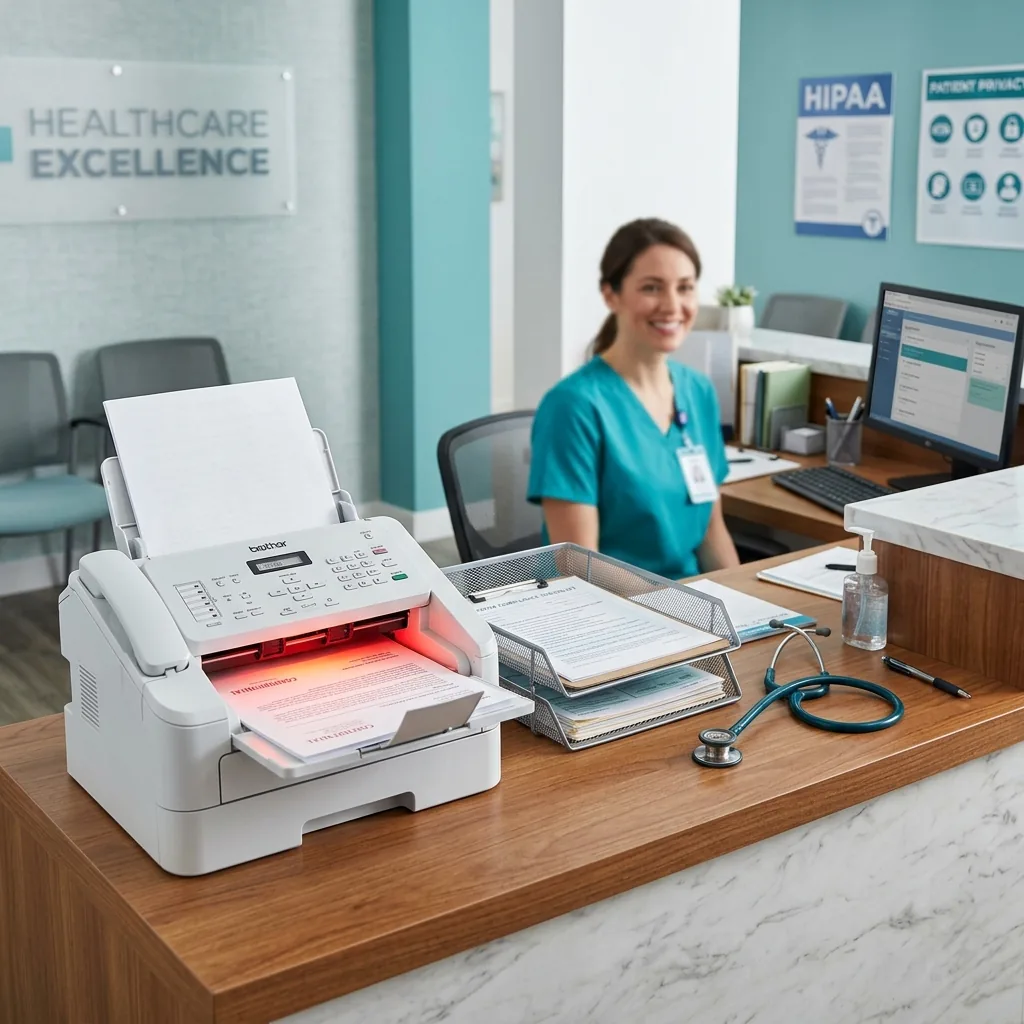
I want you to picture something.
It’s 9:07 PM on a Tuesday. Your clinic closed at 5. The lights are off. The cleaning crew is vacuuming the waiting room.
Your fax machine just printed a 12-page document from a referring physician. It contains a patient’s complete psychiatric evaluation — diagnosis, medications, treatment history, family history, and a Social Security number on the intake sheet.
That document is now sitting face-up in the fax tray. In a room with no door lock. Under fluorescent lights that are still on. And it will remain there, accessible to anyone who enters the building, until your front desk arrives in approximately 11 hours.
This isn’t worst-case scenario planning. This is a regular Tuesday at most medical practices in America.
The HIPAA problem nobody wants to audit
The HIPAA Security Rule requires “reasonable and appropriate” safeguards to protect the confidentiality, integrity, and availability of electronic Protected Health Information (ePHI). The HIPAA Privacy Rule extends protections to PHI in any form — including paper.
A fax sitting in an unattended tray in a common area is PHI that is:
- Unencrypted — it’s printed text on plain paper
- Uncontrolled — there’s no access restriction on who can see it
- Unaudited — there’s no log of who accessed, read, or removed it
- Unsecured overnight — it sits exposed during cleaning, maintenance, and after-hours access
Under the HIPAA Breach Notification Rule, an impermissible access to PHI is presumed to be a breach unless the covered entity can demonstrate a low probability that the information was compromised. Good luck making that argument about a document sitting face-up in a shared tray for 11 hours.
What the enforcement data says
The Office for Civil Rights (OCR) — the federal agency that enforces HIPAA — has made clear through enforcement actions that physical document security is not optional.
Fines for HIPAA violations fall into four tiers:
Tier 1 — Did not know: $100–$50,000 per violation Tier 2 — Reasonable cause: $1,000–$50,000 per violation Tier 3 — Willful neglect, corrected: $10,000–$50,000 per violation Tier 4 — Willful neglect, not corrected: $50,000 per violation
Annual maximum per violation category: $1.5 million.
Now ask yourself: if OCR investigates your practice and discovers that incoming faxes containing PHI routinely print and sit unattended in communal areas — and that a secure alternative costing $25/month existed the entire time — which tier do you think they’d apply?
The answer is likely Tier 2 at minimum: “reasonable cause.” You knew or should have known that your physical fax setup was creating an exposure. You had reasonable alternatives. You chose not to implement them.
The three compliance gaps physical fax creates
Gap 1: Access control failure. HIPAA requires that PHI be accessible only to authorized individuals. A fax tray has no access controls. It doesn’t check credentials. It doesn’t verify identity. It simply prints and waits for whoever walks by first.
Cloud fax solves this by routing incoming faxes as encrypted PDFs to specific, authorized recipients. Each staff member has their own login. Role-based permissions ensure that the billing department doesn’t see clinical documents and the front desk doesn’t see psychiatric evaluations.
Gap 2: Audit trail absence. HIPAA requires maintaining logs of PHI access. With a physical fax machine, there is no way to know who saw an incoming fax. No log. No record. No proof.
Cloud fax automatically generates a complete audit trail for every document — who sent it, when it arrived, who accessed it, when they opened it. If a regulator asks you to demonstrate your audit trail, you can produce it in seconds.
Gap 3: After-hours exposure. Most clinics receive faxes 24/7 — referrals from ERs, after-hours lab results, prescription requests. Physical machines print these documents regardless of whether anyone is in the office to receive them. They accumulate in the tray overnight and over weekends.
Cloud fax stores incoming documents in encrypted cloud storage until an authorized user retrieves them. No printing. No tray. No overnight exposure. Documents sit in encrypted servers, not in plastic trays.
Is faxing HIPAA compliant? The answer is complicated
This is the argument I hear most often from clinicians and practice managers. And there’s a kernel of truth in it.
The fax transmission protocol is point-to-point. Unlike email, which hops through multiple servers and can be intercepted at each node, a fax signal travels directly from the sender’s machine to the receiver’s machine. There’s no intermediate storage, no forwarding chain, no BCC vulnerability.
This is why HIPAA initially treated fax more favorably than email. The transmission itself is reasonably secure.
But the HIPAA Security Rule doesn’t stop at transmission security. It requires protection at rest — not just in transit. And a printed document sitting in an open tray is about as “at rest” as it gets, with zero protection.
The distinction matters: fax transmission is secure, but fax reception via physical machine is not. Cloud fax preserves the security of the transmission while also securing the reception — because the document never prints. It arrives as an encrypted file, stays encrypted in storage, and is accessible only to authorized users.
How to switch to a HIPAA compliant fax service
I’ve guided medical practices through this transition. Here’s the typical process.
Week 1: Sign up for a HIPAA compliant fax service — an online fax service that meets all Security Rule requirements. This is non-negotiable — the service must offer a signed Business Associate Agreement (BAA). Without a BAA, using the service for PHI is itself a HIPAA violation, regardless of how secure the technology is. Additionally, look for SOC 2 Type II certification as independent verification of their security controls.
Week 1–2: Port your existing fax number(s) to the cloud provider. During the port process, there’s no downtime — faxes continue arriving normally. Referring physicians, insurance companies, labs, and pharmacies don’t need to update anything on their end.
Week 2: Configure departmental access. Set up individual accounts for front desk, nursing, billing, and clinical staff. Assign role-based permissions so each team sees only the faxes relevant to their function.
Week 2–3: Test in parallel. Many practices run both systems simultaneously for a few days to verify everything works. Once confident, unplug the physical machines.
Week 3 onward: Reclaim the counter space, cancel the dedicated phone line, and enjoy a compliance posture that’s actually defensible.
The math that makes this obvious
The monthly cost of a physical fax line and supplies at a typical clinic runs $90–$200 depending on volume. That’s before counting staff time.
A HIPAA-compliant cloud fax service with BAA, encryption, and role-based access typically runs $15–$30/month.
The cost savings are real — but they’re not the point. The point is that for substantially less money, you get a HIPAA-compliant solution that eliminates the compliance gaps a physical machine creates.
One OCR enforcement action would cost more than you’d spend on cloud fax over the next 50 years. The ROI calculation is one of the simplest I’ve ever seen in healthcare operations.
The question every practice manager should ask this week
Walk to your fax machine right now. Look at the tray.
Is there a document in it? Can you see what’s on it from five feet away? Does it contain patient information?
If the answer to any of those is yes, you have a compliance gap that needs attention.
The good news: it’s one of the fastest and cheapest compliance wins in all of healthcare operations. The transition takes days, not months. The cost drops, not rises. And for the first time, you’ll be able to demonstrate to any regulator, auditor, or patient that you take the security of their health information seriously enough to invest $25/month in protecting it.
Frequently Asked Questions
Is fax HIPAA compliant?
The fax transmission protocol is considered HIPAA compliant because it transmits data point-to-point without intermediate server storage. However, a physical fax machine is often not HIPAA compliant in practice because printed documents sit in open trays with no encryption, no access controls, and no audit trail. To achieve true HIPAA compliance with faxing, you need a HIPAA compliant fax service that provides encryption at rest, role-based access, and a signed BAA.
Are fax machines HIPAA compliant?
Physical fax machines do not meet the HIPAA Security Rule’s requirements for access controls, encryption, or audit logging. Documents containing Protected Health Information print in communal trays accessible to anyone in the office. While fax machines aren’t explicitly banned by HIPAA, the security gaps they create make compliance very difficult to demonstrate — especially when affordable alternatives with proper safeguards exist.
Is fax to email HIPAA compliant?
Fax-to-email can be HIPAA compliant if the cloud fax service encrypts the PDF attachment, delivers it through secure channels, and has signed a Business Associate Agreement (BAA). Standard unencrypted email alone is not HIPAA compliant. But a HIPAA compliant fax service that delivers incoming faxes as encrypted PDFs to authorized recipients satisfies the Security Rule when combined with a signed BAA.
Are online fax services HIPAA compliant?
Not all online fax services are HIPAA compliant — you need to verify specific security features. Look for: a signed BAA (mandatory), 256-bit AES encryption at rest, TLS encryption in transit, SOC 2 Type II certification, role-based access controls, complete audit trails, and configurable data retention policies. Services that offer all of these meet HIPAA Security Rule requirements.
Do I need a HIPAA compliant fax service for my practice?
If your practice sends or receives any documents containing Protected Health Information (PHI) — referrals, lab results, insurance authorizations, prescription requests, or patient records — you need a fax solution that meets HIPAA Security Rule requirements. A physical fax machine with an open tray does not meet these requirements. A HIPAA compliant fax service with encryption, access controls, and audit logging does.
I help healthcare practices modernize their document workflows while strengthening HIPAA compliance. If you want a detailed comparison of HIPAA-compliant online fax services — including which ones provide signed Business Associate Agreements, SOC 2 certification, EHR integration capabilities, and team management features — I published a comprehensive guide here: Best HIPAA-Compliant Online Fax for Medical Clinics