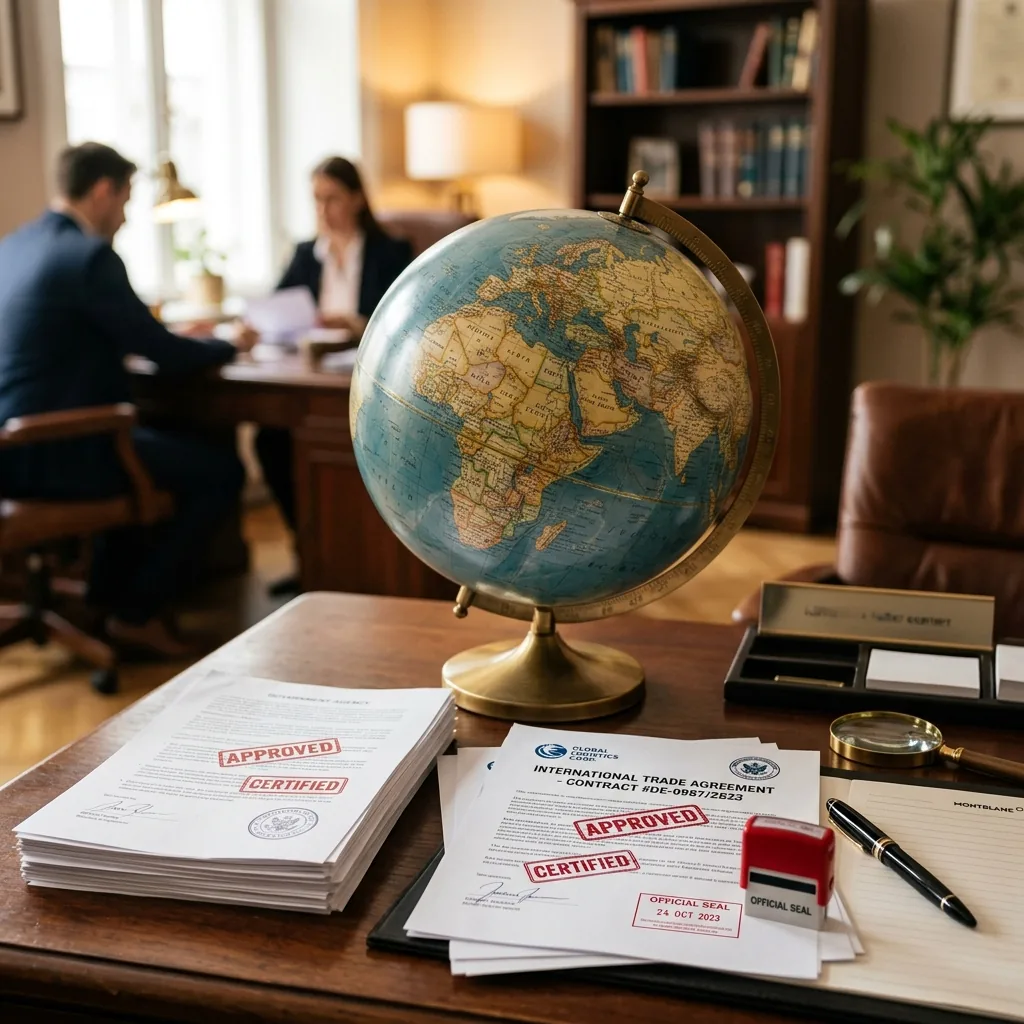
We translate certified documents — birth certificates, marriage licenses, court orders, academic transcripts, immigration filings — from a dozen languages into English and back. Our clients are individuals, law firms, immigration attorneys, and government agencies worldwide.
And for years, our single biggest operational frustration was faxing.
Not translating. Not formatting. Not managing client deadlines. Faxing. Specifically, international faxing.
Because when a German consulate needs a certified translation, they often need it faxed. When a French court requires translated divorce papers, they want a fax. When a Brazilian immigration office requests a certified translation of an American birth certificate, the submission method is — you guessed it — fax.
The protocol is universal. Government agencies around the world accept fax because the infrastructure has been in place for decades and nobody wants to replace it. The timestamps are legally defensible. The point-to-point transmission satisfies security concerns.
The problem is that international faxing through traditional methods was destroying our margins.
The per-page cost that adds up fast
Traditional international faxing charges $1–3 per page depending on the destination country and your telecom carrier.
Let me put that in context.
A typical certified translation package for immigration purposes — the original document, the translated version, the certification statement, the notarization page — runs 5–10 pages. A court document package can run 20–40 pages.
At $2 per page, a 20-page document faxed to Germany costs $40 per transmission. If transmission fails and you need to resend — which happens frequently with international fax due to line quality and timezone-related busy signals — that doubles.
We were faxing 30–50 international documents per month. At an average cost of $25–60 per transmission, our monthly international fax bill was running $750–$3,000. Per month.
For context, our average translation fee for a standard certified document is $75–150. We were spending a quarter to a half of our revenue on the fax transmission alone.
The quality problem nobody talks about
Cost was painful, but quality was worse.
Traditional analog fax degrades over distance. The longer the phone line, the more the signal deteriorates. For international transmissions, this degradation is often significant — fine details become fuzzy, thin lines blur, and small text becomes difficult to read.
This matters enormously for certified translations because the documents contain critical elements that must be legible:
Certification stamps. The translator’s certification seal must be clearly visible and readable for the document to be accepted as a certified translation.
Notary seals. Round notary embossment seals, which are already subtle in original documents, often disappear entirely in faxed copies sent over long-distance analog lines.
Official signatures. Signatures with fine lines or detailed flourishes can become illegible in degraded fax transmissions.
Small print. Certification language, disclaimers, and legal text — often in 8–9 point font — may become unreadable after international fax degradation.
We had multiple instances where receiving government agencies rejected faxed documents because certification stamps or notary seals were illegible in the received copy. Each rejection triggered a resend, another $20–60 per-page charge, and a delay that frustrated our clients and jeopardized their immigration timelines.
The timezone problem
International faxing has a practical timing issue that few people consider until they experience it.
When you fax a document from New York to a government office in Berlin at 10 AM Eastern, it’s 4 PM in Berlin. If the office closes at 5 PM and their fax machine is turned off after-hours, your transmission window is narrow.
If the first attempt fails — busy signal, machine offline, line congestion — you may not be able to complete the transmission until the next business day. In government contexts, “next business day” can mean “next week” if Friday transmissions fail.
Traditional fax requires you to be present at the machine, watching the display, ready to redial. With timezone constraints, this sometimes meant staff staying late or arriving early specifically to hit a foreign agency’s business hours.
How online fax services solved all three problems simultaneously
We switched to an online fax service about two years ago, and the impact was immediate across every dimension.
Cost: Online fax services charge flat rates regardless of destination country. Sending a fax online to France costs the same as faxing it to the office next door. Our monthly international fax bill dropped from $750–$3,000 to under $30. Not a typo. Under thirty dollars per month.
Quality: Cloud fax transmits digital files directly — the document goes from our PDF to the receiving fax machine without analog conversion at our end. The originating signal quality is as high as the source document. Certification stamps arrive crisp. Notary seals are legible. Fine text is readable.
We haven’t had a single quality-related rejection since switching. Not one.
Timing: Cloud fax services handle retries automatically. If the receiving machine is offline or busy, the service queues the fax and retries at intervals — without anyone needing to stand at a machine. We can schedule transmissions for optimal timezone windows. And we can send faxes at 2 AM our time to arrive at 8 AM in Europe — automatically, while we sleep.
The workflow transformation
Our previous international fax workflow looked like this:
Old process: Translator completes certified translation → Prints document → Walks to fax machine → Manually dials international number (often 15+ digits) → Feeds pages one at a time → Watches for connection → Waits for each page to transmit (slow for international calls) → Deals with failed connections → Re-dials → Waits again → Gets confirmation (maybe) → Manually files confirmation → Returns to desk. Total time: 15–40 minutes per document.
New process: Translator completes certified translation → Opens cloud fax app → Uploads PDF → Enters international fax number → Clicks send → Receives delivery confirmation in inbox within minutes. Total time: under 2 minutes per document.
The time savings scaled dramatically. For 30–50 monthly international transmissions, we went from 8–30 hours of fax-related labor per month to less than 2 hours.
International fax numbers: an unexpected advantage
One feature of cloud fax that we didn’t anticipate using — but ended up finding invaluable — was the ability to acquire fax numbers in different countries.
Some cloud fax providers offer numbers in dozens of countries. We got a French number and a German number in addition to our US number. This means:
When a French government agency needs to fax us a document, they fax a French number — and it costs them local rates. No international dialing. No hesitation about cost. The document arrives in our inbox as an encrypted PDF, regardless of which country’s number received it.
When a client in Germany needs to send us their original documents by fax, they use our German number. It feels local to them. The barrier to engagement drops significantly.
This was an unexpected competitive advantage. Clients and agencies in foreign countries were noticeably more responsive when they could fax a local number rather than an international one.
For solo translators too
You don’t need to be a large agency to benefit from this. Solo freelance translators with international clients face the exact same challenges — per-page international fax costs eating into thin margins, quality degradation affecting document acceptance, and timezone logistics creating workflow headaches.
Cloud fax with flat-rate international coverage levels the playing field. A solo translator working from their apartment can fax to any country in the world from their phone for a few dollars per month — the same capability that used to require expensive international calling plans and a physical machine.
The math that made this obvious
Here’s a simplified look at our costs before and after:
Before (physical international faxing):
- International per-page charges: $750–$3,000/month
- Dedicated phone line: $45/month
- Paper, toner, maintenance: $60/month
- Staff time at fax machine: 8–30 hours/month
- Quality-related resends: $200–$500/month
- Total monthly cost: $1,055–$3,605
After (cloud fax):
- Monthly subscription: $25/month
- Staff time: 1–2 hours/month
- Quality-related resends: $0
- Total monthly cost: $25
Annual savings: $12,000–$43,000. For a mid-size translation agency, that’s transformative.
The bottom line for translation professionals
If your business involves sending certified, notarized, or official documents to international recipients by fax — and you’re still using a physical machine with per-page international rates — you’re leaving thousands of dollars per year on the table.
Cloud fax eliminates the per-page cost, solves the quality degradation problem, handles timezone logistics automatically, and gives you the option of local numbers in foreign countries. The transition takes less than a day, and the savings start immediately.
I help international businesses optimize their document workflows. If you want to see a comparison of online fax services with strong international coverage, flat-rate pricing, and support for certified document transmission — I published a detailed analysis here: Best Online Fax for Translation Agencies & Certified Translators
Frequently Asked Questions
What is the best online fax service for international faxing?
The best online fax service for international use should offer: coverage in 180+ countries at flat rates (no per-page international surcharges), high-resolution document transmission that preserves certification stamps and notary seals, the ability to acquire fax numbers in multiple countries, and multi-format support for PDFs, Word documents, and images. Look for services with cross-platform apps (web, iOS, Android) and cloud archive for easy document retrieval.
Are online fax services secure for certified documents?
Yes — reputable online fax services use 256-bit AES encryption for stored documents and TLS encryption during transmission. This is actually more secure than physical international faxing, which can experience signal degradation and has no encryption for the printed output. Cloud fax keeps certified translations, notarized documents, and immigration filings encrypted at every stage.
How do online fax services work for international transmission?
You upload your document (PDF, Word, image), enter the international fax number including country code, and click send. The service routes the fax signal through its infrastructure to the destination country’s phone network. The recipient’s fax machine prints a standard fax. Quality is superior to traditional analog international faxing because the originating document is digital — no analog scanner degradation.
What is the cheapest online fax service for high-volume international use?
Look for services with flat-rate international faxing — meaning the price per page is the same regardless of destination country. Traditional per-page international fax rates of $1–3/page can cost hundreds or thousands per month for agencies with volume. Flat-rate cloud fax services typically charge $15–30/month for plans that include international coverage, representing savings of 90%+ for most translation agencies.
Is an online fax service legit for government and legal submissions?
Absolutely. Online fax services transmit standard fax signals that are indistinguishable from physical fax machine transmissions on the receiving end. Government agencies, courts, immigration offices, and consulates worldwide accept faxes from cloud services because the fax protocol is the same. The timestamped delivery confirmations actually provide better proof of submission than physical fax confirmation slips.